
A hybrid inverter must decide where solar energy goes, how much the battery can safely store, and which loads remain powered when the grid fails. By the end, you will be able to define the operating objective, size the PV, inverter and BESS correctly, separate critical circuits, and check whether the proposed equipment will work together.
Key takeaways
- Prioritise onsite loads before charging the battery or exporting solar power.
- Select the operating mode before sizing PV, storage and inverter capacity.
- Use measured load profiles, not monthly bills alone, for system sizing.
- Confirm battery, inverter, grid and backup-load compatibility before purchase.
How a Hoymiles Hybrid Inverter Routes Solar, Battery and Grid Power
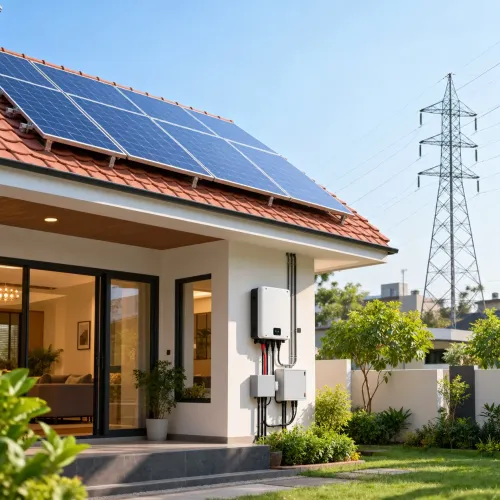
A Hoymiles hybrid inverter acts as the traffic controller between PV generation, site loads, the BESS and the utility grid. It directs available solar power to immediate consumption first, then manages battery charging, export or curtailment according to the selected operating mode and equipment limits.
- During strong solar production, PV serves household or business loads. Surplus power charges the BESS until its charge-power, state-of-charge or temperature limit is reached; remaining surplus goes to the grid or is curtailed.
- When solar output falls below demand, the inverter discharges the BESS to reduce grid imports. The grid supplies any shortfall when the battery reaches its minimum state of charge or cannot deliver the required power.
- During evening demand, battery discharging supplies the programmed loads until the reserve limit is reached. The inverter then returns those loads to grid supply unless backup operation has been configured.
- During a grid outage, the inverter isolates the designated backup output from the utility and forms a local supply. Only circuits connected through that output or an appropriately rated transfer arrangement remain energized.
A BESS must appear on the Hoymiles model-specific compatibility list. Confirm the supported CAN or RS485 protocol, because the BMS must report state of charge, temperature, charge and discharge limits, and faults; matching nominal voltage alone is insufficient.
Existing Hoymiles microinverters cannot automatically run on the backup side. An AC-coupled design needs coordinated curtailment or frequency shifting to prevent overvoltage, shutdowns or battery overcharge.
Choose the Operating Mode Before You Size the System
A standard grid-tied inverter stops supplying power when the grid fails; a hybrid inverter and BESS can isolate the site, serve selected loads and coordinate PV charging with battery discharge. That difference makes the operating objective the starting decision, not an afterthought.
| Option | What it means | When it applies |
|---|---|---|
| Hybrid inverter and BESS | One control system manages DC-coupled PV, battery, loads and grid, with a defined backup output | Grid-tied backup, self-consumption, peak-load reduction or time-of-use shifting |
| Standard grid-tied inverter | Converts PV for immediate loads or grid export but provides no stored energy during an outage | PV savings without backup |
| AC-coupled battery | A separate battery inverter charges from AC and serves loads through the distribution system | Retrofitting storage, provided both inverters coordinate curtailment when the battery is full |
| Standalone off-grid inverter | Forms the site’s own AC supply without relying on utility power | Remote sites with sufficient PV, storage and load control |
| Backup generator | Produces electricity from fuel during extended interruptions | Long outages or loads that exceed practical battery duration |
Do not place existing Hoymiles microinverter PV on a hybrid inverter’s backup side without an AC-coupling control design. Frequency shifting or curtailment must prevent overvoltage, shutdowns and battery overcharge when loads are low.
Choose off-grid operation only when the design covers every load and outage period. For a three-phase site, verify coordinated three-phase backup and phase-imbalance handling; a single-phase inverter cannot provide balanced three-phase supply by itself. For low-voltage batteries, confirm that the selected operating power fits battery current, cabling and BMS limits.
Size PV, Battery Capacity and Inverter Power from Real Loads
A 5 kW load running for four hours needs 20 kWh delivered to the AC side. That figure sets the starting point for usable battery capacity, not the battery’s nameplate energy: conversion losses, standby draw, minimum state of charge and temperature derating require additional capacity.
Measure daytime and evening demand separately. Daytime PV first serves live loads, while evening demand determines how much stored energy must remain after sunset. Record daily kWh from interval-meter data, then model these flows independently:
- PV serving loads
- PV charging the battery
- Battery serving loads
- Curtailed PV
PV array sizing must account for roof orientation, seasonal production and losses, not just daily consumption. DC-coupled charging also stops at the inverter’s battery-charge power and current limits, so a large STC-rated array can produce clipped midday energy.
Choose an inverter power rating above the highest simultaneous continuous load, including the battery’s required output. A refrigerator, pump or air conditioner can trip an inverter during starting even when its running watts fit; check locked-rotor current and the inverter’s surge duration.
Battery charge-discharge power must cover both charging from surplus PV and discharging during the site’s peak demand. A battery with enough kWh but insufficient continuous kW cannot run the load. Obtain guaranteed usable battery capacity from the warranty and inverter limits, and request AC-to-AC efficiency at defined power levels and state of charge.
Parallel modules also need approved firmware, voltage matching and current sharing.
Design the Critical-Loads Backup and Outage Response
Put only outage-essential circuits on the critical-loads subpanel. Connect that subpanel to the inverter’s designated backup output, not to an ordinary grid-connected breaker. Keep nonessential heating, cooking and charging loads outside it.
| Circuit | Backup decision | Main check |
|---|---|---|
| Refrigerator, lighting, router, security | Yes | Continuous watts and acceptable transfer time |
| Electric range, water heater, EV charger | No | High continuous demand |
| Pump, air conditioner, compressor | Only if approved | Inrush or locked-rotor current |
| Three-phase machinery | Only with coordinated three-phase backup | Phase loading and imbalance |
Treat the backup output as a separate electrical supply. It must not be tied directly to the grid or backfed into a non-isolated circuit. Confirm neutral switching, neutral-earth bonding and RCD/GFCI operation against the inverter wiring instructions and local code.
Verify these outage functions before purchase:
- Anti-islanding must disconnect the site from the utility before backup power energizes the subpanel.
- Transfer time must suit the loads; sensitive electronics may need a UPS if the interruption exceeds their ride-through time.
- Black-start capability must state whether the battery can restart the inverter without grid power, and what battery state of charge is required.
- Solar charging during an outage must be documented, including PV curtailment, battery charge limits and operation when the battery is full.
- For motors and transformers, compare locked-rotor or inrush current with the inverter’s surge duration, not just running watts.
A single-phase inverter cannot independently provide balanced three-phase backup. Confirm coordinated three-phase support and the allowable load on each phase.
Verify Hoymiles, Battery and Site Compatibility Before Purchase
Do not approve a quote from nominal voltage and kWh alone. Require the Hoymiles model-specific battery compatibility list, supported CAN or RS485 communications profile, and installation manual. The BMS must report state of charge, allowable charge and discharge current, temperature and faults; a battery that fits electrically can still be unsupported.
1. Confirm the battery voltage range against the inverter’s operating window, then check continuous current. A 6 kW load on a 48 V battery draws about 125 A, rising to about 143 A at 42 V before losses. Match that demand to BMS limits, cable size, connectors, fuse rating and isolator rating.
2. For parallel batteries, request the approved architecture, firmware requirements, voltage and state-of-charge matching procedure, and current-sharing method. One module reaching its BMS limit first can disconnect the bank and interrupt backup.
3. Check every PV string against maximum DC power and MPPT voltage and current limits. Calculate cold-weather open-circuit voltage, not just operating voltage, and add string fuses and surge protection where the design requires them.
4. Review the single-line diagram for phase arrangement, backup gateway, neutral switching, critical-load circuits, main distribution board, earthing, AC breakers, DC isolators, SPDs and RCD compatibility. Three-phase sites need documented phase coordination and imbalance limits.
5. Demand factory settings, test results and a signed commissioning report, including BMS communication, transfer operation, islanding protection, battery temperature response and backup-load testing. Ask Madhuri Solar to resolve any mismatch on these documents before purchase.
Related product
 | Solar Dual Water Pumping System The Solar Dual Water Pumping System efficiently harnesses solar energy to power two independent water pumps, providing a sustainable solution for... View product → |
Frequently asked questions
How does a Hoymiles hybrid inverter route solar, battery and grid power?
It supplies immediate site loads first, then directs surplus solar to battery charging, grid export or curtailment according to the operating mode and equipment limits.
How should you size PV, battery capacity and inverter power?
Use measured load profiles, peak demand, daily energy use, outage requirements and the selected operating mode rather than relying on monthly consumption alone.
How do you design backup power for critical loads?
List essential circuits, calculate their starting and running loads, separate them from noncritical circuits and define the required outage duration before sizing the backup system.
What compatibility checks are needed before buying a Hoymiles hybrid inverter and BESS?
Verify inverter and battery voltage ranges, communication protocols, approved battery models, AC and DC ratings, grid requirements and the site’s backup-panel configuration.