Reliable storage depends on more than adding a battery to a solar installation: the inverter must coordinate generation, loads, grid power, battery limits, and safe islanding. By the end, you will be able to distinguish the main storage architectures, identify the circuits a backup system can support, calculate a sensible starting size, and check whether a Hoymiles system and battery are genuinely compatible.
Key takeaways
- Route solar power between loads, batteries, exports, and grid protection limits.
- Choose AC or DC coupling based on retrofit needs, conversion losses, and system architecture.
- Back up only circuits connected to the inverter’s protected-load output.
- Size inverter power for simultaneous loads and battery energy for required runtime.
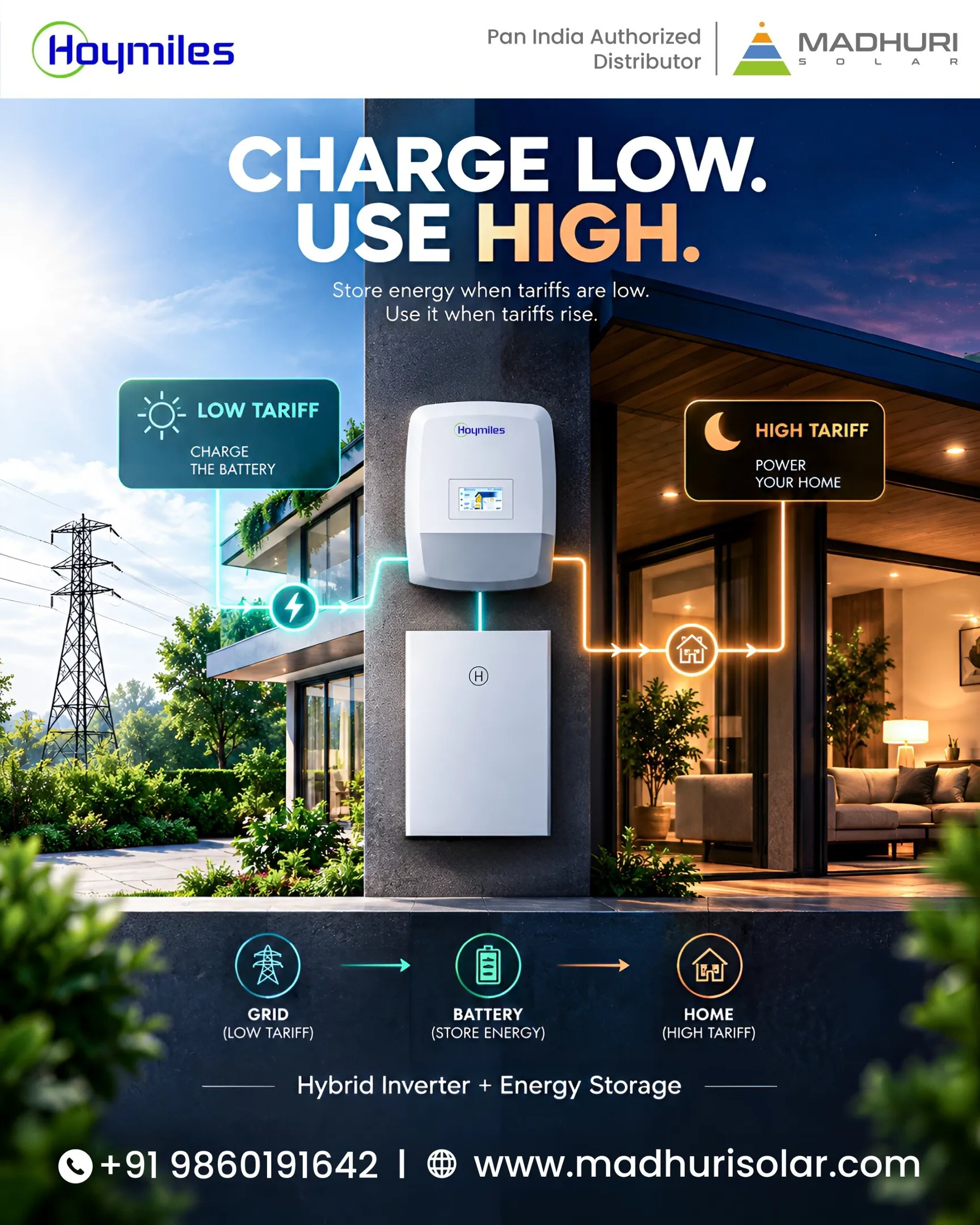
How a Hoymiles hybrid inverter coordinates solar, loads, grid and battery power
Solar generation is routed first to household loads or commercial loads overview demand. A Hoymiles hybrid inverter sends surplus power to the battery, exports it to the grid, or limits output when charging and export limits are reached.
When solar output falls, it can discharge the battery before importing grid electricity, according to its operating settings and state of charge.
For a commercial loads overview, map which equipment runs continuously, which starts with a surge, and which circuits must remain powered during an outage. During grid failure, the inverter disconnects from the utility and forms a local AC network for designated backup circuits.
It cannot support every circuit unless the backup hardware, phase arrangement and inverter rating match those loads.
| Option | Energy-flow behaviour | Main limitation |
|---|---|---|
| Hoymiles hybrid inverter | Coordinates PV, battery, loads and grid; can form backup power when configured for islanding | Backup applies only to connected, suitably sized circuits |
| Standard on-grid inverter | Supplies loads and exports surplus PV to the grid | Shuts down when the grid fails; no battery dispatch |
| Off-grid inverter | Uses PV and batteries as the primary supply, with optional generator input | Requires enough storage and generation because grid support is absent |
A hybrid system can curtail PV when the battery is full or backup demand is low. A standard on-grid inverter does not provide that storage-based control, while an off-grid inverter does not normally balance energy around an available utility connection.
What a BESS contains and why AC-coupled and DC-coupled designs behave differently
A BESS combines energy storage, control, conversion and safety equipment; the battery modules alone cannot supply usable power to a building. Its main parts are:
- Battery modules, racks, contactors and thermal management
- A battery-management system that monitors cell voltage, temperature and state of charge
- A power-conversion system (PCS) or inverter hardware that converts DC and AC power
- Fuses, disconnects, surge protection, wiring and an enclosure
- Monitoring, communications and controls for alarms, charging limits and shutdowns
| Energy path | Best fit | Main trade-off |
|---|---|---|
| AC-coupled | Retrofit: add a battery inverter beside an existing solar inverter | Flexible installation, but charging and discharging add conversion stages and losses |
| DC-coupled | New installation using a compatible hybrid inverter | More direct PV-to-battery charging, but PV voltage, battery voltage range and controls must match |
Choose AC coupling when the existing PV inverter remains serviceable and replacing it would add cost or downtime. Choose DC coupling for a new system when the hybrid inverter accepts the planned PV array and battery directly.
Do not compare capacity alone. An MS-A2, with about 2.24 kWh stated capacity and an approximately 800 W bidirectional stage, suits load shifting or selected backup circuits—not whole-building loads. Request usable AC energy at a stated power and temperature.
What happens during a grid outage—and which circuits receive backup power
A grid failure does not make every circuit live automatically. A Hoymiles hybrid inverter can disconnect from the utility and form a local island, but backup requires a compatible battery, correct commissioning, and an automatic transfer switch or backup gateway that isolates the backup output from utility wiring. Without that isolation, unsafe backfeed can occur.
| Arrangement | What receives power during an outage | Main check |
|---|---|---|
| Critical-load panel | Designated circuits only | Confirm breaker ratings and load priorities |
| Whole-building backup | The complete distribution board | Verify inverter power, transfer equipment and phase capacity |
| No backup wiring | No circuits | The EPS output or backup output remains unavailable |
Connect refrigerators, communications equipment, security systems and selected lighting to the backed-up panel. Leave electric heating, large water heaters and nonessential workshop loads outside it unless the inverter and battery are sized for them.
For a three-phase installation, verify that the selected model supplies all required phases while islanded. The HYT-HV-EUG1 family uses three-phase conversion, but a three-phase grid connection alone does not prove three-phase backup capability. Check phase imbalance limits and whether critical equipment needs phase-to-phase voltage.
List every motor’s starting current. A 10 kW inverter can still fail to start a well pump, compressor or HVAC unit if its inrush exceeds the overload curve. Use soft starters or staggered starts where needed.
How to size inverter power and battery energy for real loads
Size the inverter for power in kilowatts and the battery for stored energy in kilowatt-hours; these are separate decisions. A large battery cannot compensate for an inverter that cannot start or run the load.
1. Measure every backed-up circuit and record its running watts. Add simultaneous loads to find peak load, rather than adding every appliance nameplate rating.
2. Check starting current for pumps, compressors, refrigerators, air conditioners and transformers. Compare their inrush watts and duration with the inverter’s overload curve; a 10 kW continuous rating may still fail to start a motor.
3. Set inverter sizing from the greater of simultaneous running demand and required starting demand. Confirm continuous output, short-duration surge, phase allocation and battery discharge limits. A 12 kW inverter on a 48 V battery draws about 250 A before conversion losses.
4. For battery sizing, multiply the required load in kW by backup hours, then divide for inverter losses, reserve state of charge and temperature derating. Compare this result with usable AC energy, not nominal battery kWh. Daily energy use helps size load shifting, while outage duration sets backup capacity.
5. Compare solar production with daytime loads and charging power. PV oversizing can improve annual capture, but clipping, export limits and battery charge limits still restrict instantaneous output. An approximately 2.24 kWh MS-A2 suits selected loads, not whole-home demand.
How to compare usable capacity and verify Hoymiles battery compatibility
A 10 kWh nameplate capacity does not mean 10 kWh reaches your loads. Usable capacity is reduced by the permitted depth of discharge, reserve state of charge, inverter low-voltage shutdown, temperature derating, cable losses and standby consumption.
Round-trip efficiency also measures charge-and-discharge losses under test conditions, not guaranteed annual delivery; AC-coupled systems add further conversion losses.
| Measure | Nameplate figure | Procurement figure |
|---|---|---|
| Energy | Total battery kWh | Usable AC kWh at stated power and temperature |
| Efficiency | Advertised round-trip efficiency | Delivered energy after conversion, standby and cable losses |
| Power | Battery’s nominal rating | Continuous and peak charge/discharge power |
Confirm compatibility with the exact Hoymiles inverter model before purchase:
- Match the battery’s voltage operating window, maximum charge current, maximum discharge current and inverter low-voltage cutoff.
- Check that the battery appears on Hoymiles’ approved battery compatibility list for the selected firmware and system topology.
- Confirm supported communication hardware and protocol, such as CAN or RS485, including pinout, baud rate and termination.
- Verify that the data link carries state of charge, charge limits, discharge limits, temperature and fault status; voltage-only control cannot reliably enforce those limits.
- Request a commissioning record showing successful pairing, charge, discharge and fault-response tests.
A compact product such as the MS-A2, stated at about 2.24 kWh and 800 W, is not equivalent to a whole-home BESS.
How to specify a reliable Hoymiles storage system for procurement and installation
Request a signed single-line diagram, equipment schedule and commissioning scope before approving a quote. The proposal must identify battery voltage, continuous and peak charge/discharge current, DC fuses, isolators, cable sizes, busbars, earthing, phase arrangement and backup transfer equipment.
| Option | Electrical specification | Decision check |
|---|---|---|
| HYS-LV-USG1 | 48 V battery architecture; up to about 12 kW means roughly 250 A at 48 V before losses | Confirm battery current limits, DC protection, conductor sizing and parallel-battery rules |
| HYT-HV-EUG1 | High-voltage battery with three-phase conversion | Confirm whether backup covers all phases, phase-imbalance limits and equal islanded output |
| MS-A2 | About 2.24 kWh stated capacity and 800 W bidirectional power stage | Use for smaller loads, not as a substitute for a multi-kilowatt whole-home system |
Also request these documents and test conditions:
- The exact Hoymiles compatibility-list entry, battery model and firmware versions. The battery and inverter must exchange state-of-charge, charge, discharge and fault data through CAN or RS485; nominal voltage alone proves nothing.
- Usable AC energy at a stated output power and temperature, including reserve, conversion losses, temperature derating and low-voltage shutdown.
- Operating-temperature range, enclosure rating, clearance, ventilation, smoke or heat detection and fire-control design.
- UL 9540 and UL 9540A evidence where applicable, plus the adopted electrical and fire-code basis, including NFPA 855 where used.
Ask Madhuri Solar to identify who completes protection settings, communications commissioning, permits, inspection records and outage testing. An installation certificate is not a substitute for battery safety certification.
Related products
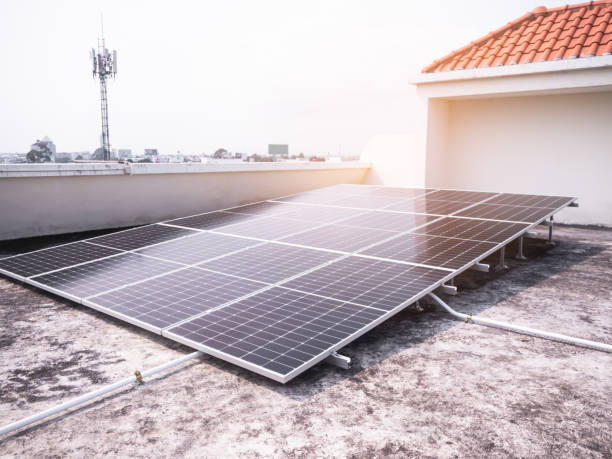 | Solar Rooftop Ongrid System A Solar Rooftop Ongrid System is an efficient, eco-friendly solution that converts sunlight into electricity. View product → |
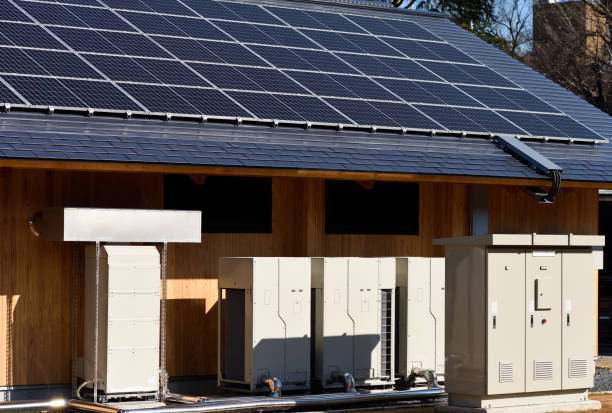 | Solar Offgrid System A Solar Offgrid System is an independent energy solution that operates without relying on the main power grid. View product → |
Frequently asked questions
How does a Hoymiles hybrid inverter manage solar, loads, the grid, and a battery?
It supplies active loads first, then directs surplus solar to battery charging or grid export, subject to charge, export, and inverter limits.
What is the difference between AC-coupled and DC-coupled battery storage?
AC-coupled systems add a battery inverter on the AC side, while DC-coupled systems connect battery storage within the solar DC architecture and can reduce conversion stages.
Which circuits receive power during a grid outage?
Only circuits wired to the inverter’s backup or protected-load output receive power, and their combined demand must remain within the inverter’s backup rating.
How do you size a battery and inverter for real loads?
Add the wattage of loads that may run simultaneously to size inverter power, then multiply required load power by backup hours and adjust for usable capacity and losses.
How do you verify Hoymiles battery compatibility?
Check the exact inverter and battery model numbers, operating-voltage range, maximum charge and discharge current, communication protocol, firmware requirements, and approved compatibility documentation.